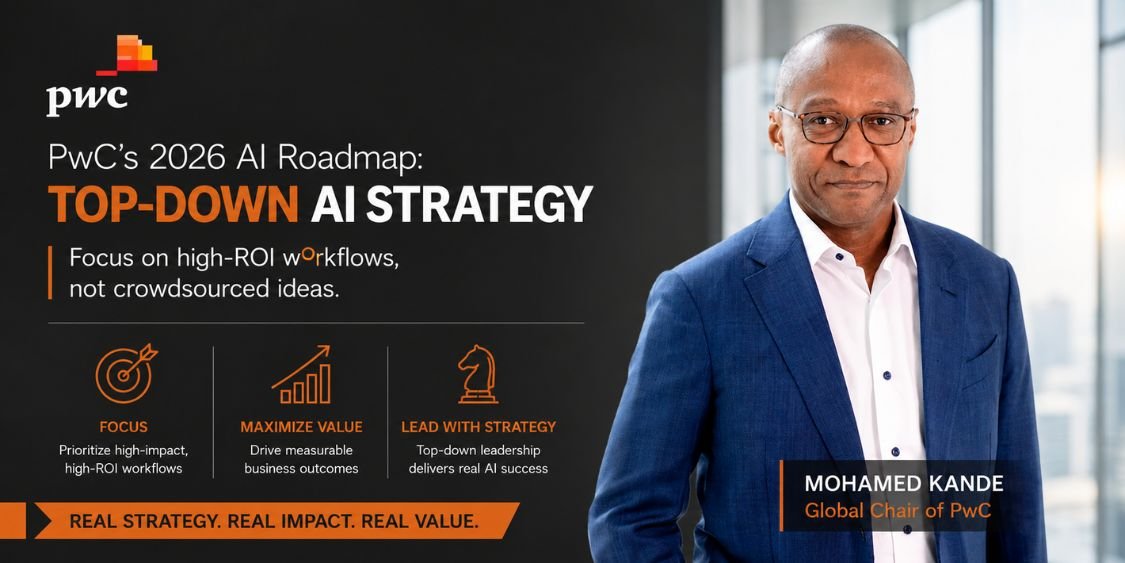
PwC has unveiled a new artificial intelligence roadmap for 2026, urging entrepreneurs to rethink how they invest in AI. According to Mohamed Kande, businesses should adopt a “Top-Down” AI strategy—prioritizing high-return workflows and measurable business outcomes instead of crowdsourcing scattered AI ideas across teams.
The guidance signals a major shift in enterprise AI planning, focusing less on experimentation and more on targeted execution. For entrepreneurs navigating an increasingly competitive AI-driven economy, the PwC Top-Down AI Strategy 2026 is emerging as a practical blueprint for sustainable growth.
Why PwC Is Recommending a Top-Down AI Approach
For the past several years, many organizations have approached AI through broad internal brainstorming, encouraging employees across departments to suggest automation opportunities. While this method generated enthusiasm, it often led to fragmented projects with unclear business impact.
PwC’s 2026 roadmap argues that AI investments should now begin at the leadership level. Decision-makers are encouraged to identify critical workflows—such as customer operations, financial analysis, supply chain optimization, and strategic forecasting—where AI can deliver measurable returns quickly.
According to Mohamed Kande, businesses that align AI implementation directly with strategic priorities are more likely to achieve scalable and profitable outcomes.
High-ROI Workflows Become the New AI Priority
At the center of the PwC Top-Down AI Strategy 2026 is a clear focus on return on investment.
Rather than deploying AI across multiple experimental use cases, entrepreneurs are being advised to prioritize areas where automation can improve efficiency, reduce costs, and generate faster decision-making advantages.
Examples of high-ROI AI workflows include:
- Intelligent customer service automation
- AI-powered market and financial analytics
- Predictive operational planning
- Automated compliance and risk management
This targeted model allows businesses to measure AI success more effectively while reducing unnecessary spending on low-impact initiatives.
Why the Strategy Is Trending in 2026
The PwC Top-Down AI Strategy 2026 is gaining significant attention because many companies are entering a new phase of AI maturity. After years of testing generative AI tools, business leaders are now demanding tangible business value rather than experimentation alone.
Entrepreneurs, startups, and enterprise executives alike are increasingly under pressure to justify AI budgets. PwC’s framework provides a timely answer: invest in AI where results can be clearly tracked and linked to business growth.
The strategy also reflects a broader market trend in which AI is moving from innovation labs into core business operations.
What Mohamed Kande’s Message Means for Entrepreneurs
Mohamed Kande’s recommendation represents a strategic mindset shift for entrepreneurs. Instead of asking teams, “Where can we use AI?” leaders are now being encouraged to ask, “Which business priorities will AI improve most?”
This top-down perspective can help founders avoid costly AI distractions while accelerating competitive advantage in a crowded market.
For startups and established businesses alike, adopting a disciplined AI roadmap may become essential for staying relevant in 2026 and beyond.
As organizations refine their AI investment strategies, PwC’s top-down model could become the standard framework guiding the next wave of enterprise transformation.
Also Read: Lidiane Jones Bumble AI Strategy Sparks New Networking Era