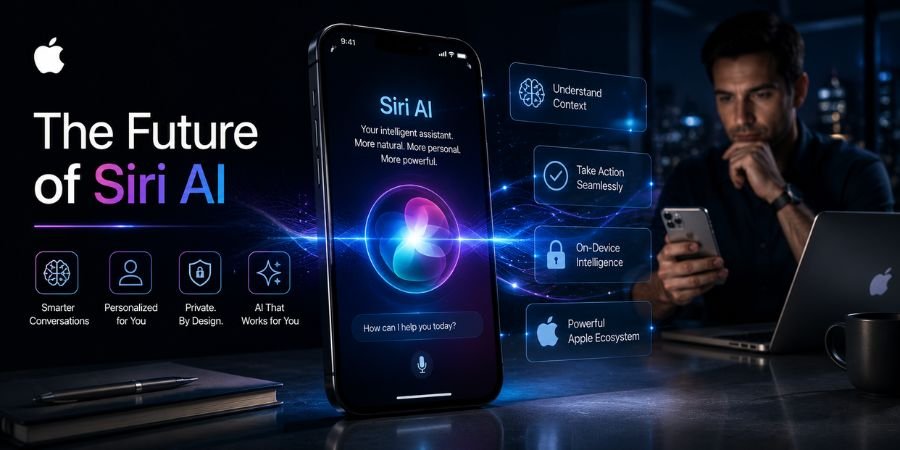
Apple’s voice assistant is undergoing one of its most significant transformations since its debut, as Apple introduces a new wave of AI-driven capabilities under its “Apple Intelligence” framework. The Apple Siri AI Upgrade represents a shift from a traditional command-based assistant to a more context-aware, personalized system capable of understanding natural language, app context, and on-device user intent.
Rather than being a standalone feature, this evolution is deeply integrated into Apple’s ecosystem across iPhone, iPad, and Mac devices. It reflects Apple’s broader strategy to embed generative AI into everyday interactions while maintaining its long-standing focus on privacy and on-device processing.
A new chapter for Siri inside Apple Intelligence
The Apple Siri AI Upgrade is part of Apple’s larger “Apple Intelligence” initiative announced at WWDC 2024. Instead of rebuilding Siri as a separate product, Apple is embedding advanced AI capabilities directly into its operating systems.
This includes a more natural conversational experience, improved understanding of context across apps, and the ability to perform more complex multi-step tasks. Siri is now designed to interpret not just voice commands, but also screen context and user activity.
The upgrade also introduces deeper integration with OpenAI technology through optional ChatGPT support, allowing Siri to extend its capabilities when needed for more complex queries.
What the Apple Siri AI Upgrade actually changes
At its core, the Apple Siri AI Upgrade focuses on making Siri more useful in real-world tasks rather than simple voice commands.
Instead of responding only to direct prompts like “set a timer” or “send a message,” Siri is now designed to understand layered instructions such as editing a photo, summarizing content, or taking action across multiple apps.
A key improvement is contextual awareness. Siri can now reference what is currently on the screen and act accordingly, reducing the need for repeated instructions or manual navigation.
Another important change is personalization. The assistant can learn user preferences over time while processing much of this information directly on-device to protect privacy.
Apple Siri AI Upgrade and on-device intelligence
A defining element of the Apple Siri AI Upgrade is Apple’s emphasis on on-device processing. Many AI functions run directly on iPhones and Macs using Apple Silicon, reducing reliance on cloud computing.
This approach improves both speed and privacy. Sensitive data such as messages, photos, and personal context is processed locally whenever possible.
For more complex tasks that require external computation, Apple uses Private Cloud Compute systems designed to avoid storing or exposing user data. This hybrid model is a key differentiator in Apple’s AI strategy compared to many cloud-first competitors.
Why Apple is upgrading Siri now
The timing of the Apple Siri AI Upgrade reflects growing competition in the AI assistant space. Over the past few years, generative AI tools have reshaped user expectations for digital assistants.
Users now expect assistants to understand context, generate content, summarize information, and perform multi-step reasoning. Traditional voice assistants were not designed for this level of capability.
Apple’s response is to evolve Siri into a more intelligent system without abandoning its privacy-first positioning. Instead of launching a separate chatbot product, Apple is embedding AI into core system experiences.
How Siri is becoming more “personal”
One of the most important goals of the Apple Siri AI Upgrade is personalization. Apple is moving toward an assistant that understands user habits, routines, and app usage patterns.
For example, Siri can now help users find information across emails, messages, files, and apps using natural language. A user might ask for “the document I shared last week,” and Siri can locate it without requiring exact file names.
This level of personalization is powered by on-device semantic indexing, allowing Siri to understand meaning rather than just keywords.
Integration with apps and system-wide intelligence
The Apple Siri AI Upgrade also expands Siri’s ability to interact with apps more intelligently. Instead of basic shortcuts, Siri can now execute multi-step actions inside and across applications.
For example, a user could ask Siri to edit a photo and send it to a contact, or summarize a webpage and save it as a note. These actions are designed to feel more like task completion rather than simple command execution.
Apple is enabling developers to integrate these capabilities through updated system APIs, allowing third-party apps to participate in the AI ecosystem.
The role of ChatGPT-style AI in Siri’s evolution
A major milestone in the Apple Siri AI Upgrade is the optional integration of external generative AI systems. Apple confirmed that Siri can route certain complex queries to ChatGPT, powered by OpenAI, when appropriate.
This does not replace Siri but extends its capabilities. For instance, if Siri cannot answer a complex reasoning question, it may use ChatGPT to generate a response while maintaining user privacy protections.
Apple emphasizes user control in this process, including prompts that ask for permission before sharing data with external AI services.
Privacy-first design in Apple’s AI strategy
Privacy remains central to the Apple Siri AI Upgrade. Unlike many AI systems that rely heavily on cloud processing, Apple’s model prioritizes local computation.
When cloud processing is required, Apple uses anonymized and encrypted systems designed to prevent data retention and tracking.
This approach reflects Apple’s long-standing positioning that user data should remain under user control, even in advanced AI environments.
Challenges and limitations of the Siri transformation
Despite its advancements, the Apple Siri AI Upgrade faces several challenges.
One limitation is the gradual rollout of features across devices. Not all AI capabilities are available on older hardware, as many require Apple Silicon chips.
Another challenge is consistency. As Siri integrates multiple AI systems and app-level actions, maintaining a seamless experience across all scenarios is complex.
There is also the broader industry challenge of ensuring AI accuracy, especially when handling open-ended or sensitive queries.
Expert perspective on Apple’s AI direction
Industry analysts generally view Apple’s approach as cautious but strategically strong. Instead of rushing a standalone AI chatbot, Apple is embedding intelligence into its ecosystem.
The Apple Siri AI Upgrade reflects a hybrid model: combining traditional voice assistant functionality, on-device machine learning, and selective generative AI integration.
This positions Siri as part of a broader ecosystem rather than a standalone competitor to chat-based AI tools.
Future outlook for Siri and Apple Intelligence
Looking ahead, the Apple Siri AI Upgrade is expected to expand further as Apple continues refining its AI stack.
Future improvements are likely to include deeper cross-app reasoning, more advanced personalization, and expanded developer tools for AI-native applications.
Apple’s long-term direction suggests a future where Siri becomes less of a “tool” and more of an embedded intelligence layer across the entire Apple ecosystem.
As AI continues to evolve, Siri’s transformation represents Apple’s attempt to balance innovation with its core principles of privacy, security, and ecosystem control.
Final perspective on Apple Siri AI Upgrade
The Apple Siri AI Upgrade marks a significant shift in how Apple approaches artificial intelligence. Rather than competing directly with standalone AI chatbots, Apple is integrating intelligence into the fabric of its devices.
This strategy focuses on usability, privacy, and deep system integration rather than purely conversational AI expansion. While challenges remain, Siri is clearly evolving into a more capable and context-aware assistant.
In the broader AI landscape, this upgrade positions Apple as a key player in redefining how personal assistants operate in the era of generative intelligence.
Frequently Asked Questions (FAQs)
1. What is the Apple Siri AI Upgrade?
The Apple Siri AI Upgrade refers to Apple’s integration of advanced AI features into Siri under its Apple Intelligence system, making the assistant more context-aware and personalized.
2. How is Siri changing with Apple Intelligence?
Siri now understands screen context, performs multi-step tasks, and integrates more deeply with apps, improving overall usability and automation across Apple devices.
3. Does Siri use ChatGPT technology?
Yes, Apple allows Siri to optionally integrate with ChatGPT from OpenAI for complex queries, with user permission and privacy safeguards in place.
4. Is the Apple Siri AI Upgrade available on all devices?
No, many advanced features require newer Apple devices with Apple Silicon chips, meaning older hardware may not support the full set of AI capabilities.
5. How does Apple ensure privacy in Siri AI features?
Apple uses on-device processing and Private Cloud Compute systems to minimize data exposure, ensuring user information is not stored or tracked unnecessarily.
6. Why is Apple upgrading Siri now?
The upgrade responds to rapid advances in generative AI and rising user expectations for smarter, more capable digital assistants in everyday workflows.