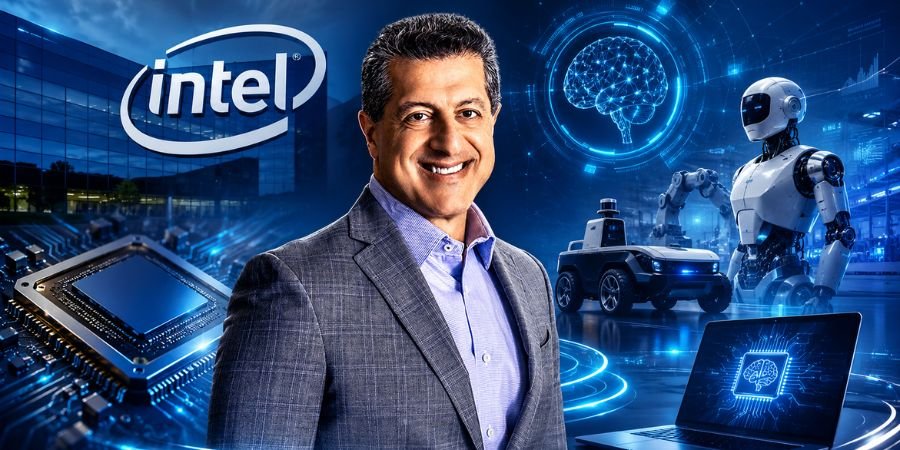
Intel has officially appointed Alex Katouzian as Executive Vice President, placing him in charge of the company’s newly formed “Client Computing & Physical AI Group.” The move represents one of Intel’s boldest strategic shifts in recent years as the semiconductor giant aims to combine traditional PC technology with robotics and autonomous AI-driven machines.
The announcement immediately drew attention across the global technology industry because Katouzian will lead Intel’s effort to transform the modern personal computer into what the company describes as a “Physical AI hub.” The new division will reportedly focus on integrating advanced AI capabilities into hardware systems designed for robotics, automation, and next-generation computing.
Intel Reshapes Its AI Strategy
The Alex Katouzian Intel appointment 2026 announcement comes at a critical time for Intel Corporation as competition intensifies in the artificial intelligence chip market. Intel has been under pressure to strengthen its position against rivals expanding aggressively into AI hardware and autonomous technologies.
Katouzian brings decades of experience in mobile processors and connected computing. Before joining Intel, he held senior leadership roles at Qualcomm, where he played a major role in developing smartphone and edge-computing platforms.
Industry analysts believe his expertise in combining hardware efficiency with AI-powered systems could help Intel accelerate innovation in robotics and smart computing devices.
Why Entrepreneurs Are Watching Closely
The Alex Katouzian Intel appointment 2026 story is trending because it signals a broader shift in how technology companies view the future of computing.
For years, PCs were primarily designed for productivity, gaming, and enterprise software. Intel’s new direction suggests that future computing devices may operate as autonomous AI systems capable of interacting with the physical world through robotics, sensors, and machine intelligence.
This approach is especially important for startups and tech entrepreneurs building products around automation, smart manufacturing, autonomous machines, and AI-powered edge devices. Many experts see Intel’s new “Physical AI” initiative as a blueprint for the next generation of hardware startups.
The appointment also reflects a growing industry trend toward merging AI software directly with physical computing infrastructure rather than relying entirely on cloud-based systems.
Physical AI Could Redefine the PC Industry
Intel’s creation of the Client Computing & Physical AI Group suggests the company is preparing for a future where PCs evolve beyond traditional desktops and laptops.
Under Katouzian’s leadership, Intel is expected to explore technologies that combine AI processing, robotics integration, machine perception, and autonomous decision-making into a single computing ecosystem.
The concept of “Physical AI” has gained momentum as businesses seek faster, more efficient systems capable of operating independently in real-world environments. This includes applications in industrial automation, healthcare robotics, logistics, smart homes, and autonomous mobility.
By positioning AI directly inside physical devices, Intel may be aiming to reduce latency, improve privacy, and enable real-time machine intelligence without constant cloud connectivity.
Intel’s Leadership Bet on AI Hardware
The Alex Katouzian Intel appointment 2026 move also highlights how aggressively major semiconductor companies are investing in AI-focused leadership.
Intel’s decision to recruit a high-profile executive with deep mobile and edge-computing expertise indicates that the company sees autonomous systems and AI-enabled hardware as a long-term growth opportunity.
Technology investors and enterprise leaders are expected to monitor how quickly Intel can convert this strategic vision into commercially viable products.
If successful, Katouzian’s leadership could help redefine the role of PCs and position Intel at the center of the emerging Physical AI economy.
Also Read: Morten Wierod ABB Robotics Vision Redefines Startup Survival