A founder sits down late at night to review software expenses and suddenly notices that one tool is eating a huge chunk of the monthly budget. The team only uses a fraction of its features, yet the invoice keeps growing every quarter. That moment has become surprisingly common across startups, agencies, and even mid-sized businesses. In 2026, many companies are rethinking bloated software stacks and moving toward leaner platforms that actually match how modern businesses operate. This shift has pushed bootstrapped SaaS alternatives to HubSpot into the spotlight. Instead of raising massive venture funding and building endless feature layers, these products focus on usability, affordability, and customer-driven innovation. Businesses now care less about flashy enterprise branding and more about practical workflows, sustainable pricing, and software that feels built for real users rather than investors.
The Massive Shift Away From Overcomplicated CRM Platforms
For years, large CRM ecosystems dominated the market because businesses believed they needed an all-in-one platform with hundreds of integrations, dashboards, and automation layers. Over time, many teams realized they were paying for complexity they rarely used. The bigger the platform became, the harder it was to onboard employees, maintain workflows, and avoid unnecessary costs.
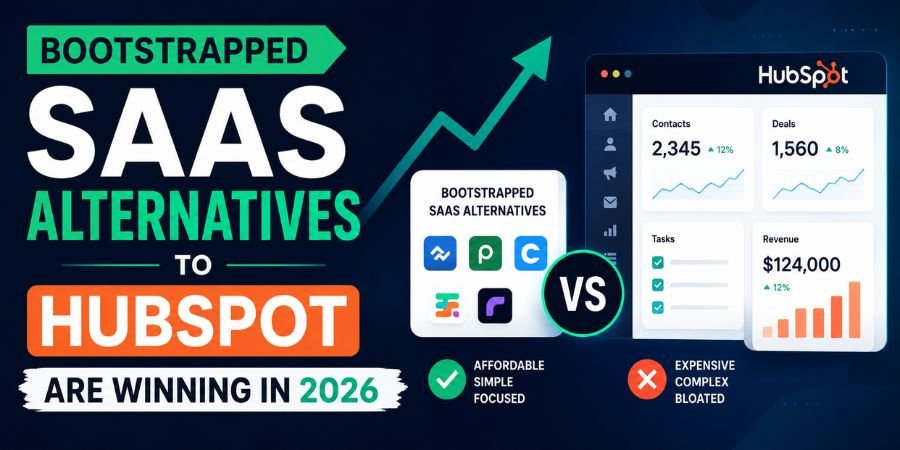
This is one of the biggest reasons bootstrapped SaaS alternatives to HubSpot are gaining momentum in 2026. Smaller software companies are proving that focused products often outperform giant platforms in day-to-day business operations. Instead of overwhelming users with enterprise-level functionality, they simplify customer management, email marketing, analytics, and automation into clean systems that teams can actually manage.
Another major factor is flexibility. Venture-funded software businesses often chase aggressive growth targets, which can lead to sudden pricing increases or forced upsells. Bootstrapped SaaS companies usually grow slower and prioritize sustainable customer relationships. That difference is becoming increasingly important for startups trying to protect cash flow.
Why Businesses Are Searching for Bootstrapped SaaS Alternatives to HubSpot
The demand for bootstrapped SaaS alternatives to HubSpot is not driven by price alone. Companies are also frustrated with software fatigue. Teams are tired of learning complicated systems that require expensive consultants or technical specialists.
Here are some common reasons businesses are switching:
- Rising subscription costs
- Complex onboarding processes
- Too many unused features
- Difficult automation setups
- Limited customization for smaller teams
- Overwhelming interfaces
- Locked premium features
- Expensive scaling costs
Smaller SaaS platforms are responding by building tools specifically for creators, founders, agencies, and lean marketing teams. Instead of trying to serve every industry on the planet, they solve focused problems extremely well.
That approach creates a better customer experience. Users can launch campaigns faster, manage leads more efficiently, and train new employees without spending weeks navigating documentation.
What Makes a Bootstrapped SaaS Product Different?
The phrase “bootstrapped SaaS” has become much more meaningful over the last few years. It no longer simply refers to a company without outside investment. In many cases, it reflects an entirely different business philosophy.
Bootstrapped SaaS companies often operate with:
- Smaller teams
- Faster product iteration
- Direct customer feedback loops
- Sustainable pricing models
- Less corporate bureaucracy
- Community-focused development
- Long-term product stability
This structure changes how software evolves. Instead of prioritizing investor expectations, bootstrapped founders usually focus on customer retention and product quality.
That matters because CRM and marketing platforms are deeply integrated into daily operations. Businesses want tools they can trust for years without worrying about unpredictable platform shifts.
The Hidden Cost Problem With Large CRM Platforms
At first glance, enterprise CRMs sometimes appear affordable. A company signs up with a starter plan and assumes costs will remain manageable. The reality becomes very different once the business grows.
Additional contacts, advanced automations, premium integrations, reporting tools, and team permissions often trigger steep pricing increases. Many businesses discover that scaling their CRM becomes more expensive than expected.
Bootstrapped SaaS alternatives to HubSpot are attracting attention because they frequently use transparent pricing models. Some charge flat monthly rates, while others offer generous feature access without aggressive upselling.
For startups and growing agencies, predictable software costs matter enormously. Cash flow planning becomes easier when critical tools do not suddenly double in price.
Best Types of Bootstrapped SaaS Alternatives to HubSpot
Not every business needs the same CRM or marketing platform. Some companies prioritize email automation, while others need pipeline management or customer support.
The strongest bootstrapped SaaS alternatives to HubSpot usually fall into several categories.
Lightweight CRM Platforms
These tools focus on lead management, pipelines, and contact organization without overwhelming users with unnecessary enterprise modules.
Popular features often include:
- Visual sales pipelines
- Team collaboration
- Email tracking
- Contact segmentation
- Activity logging
- Meeting scheduling
Many founders prefer lightweight CRMs because they reduce onboarding time and allow teams to stay productive.
Email Marketing Focused Platforms
Some bootstrapped products specialize in email campaigns and audience engagement rather than full-scale CRM complexity.
These tools commonly provide:
- Newsletter automation
- Customer segmentation
- Campaign analytics
- Subscriber tagging
- Landing pages
- Drip campaigns
Businesses that primarily rely on email marketing often discover they do not actually need a massive all-in-one ecosystem.
Marketing Automation Tools
Automation has become essential in modern business operations. However, not every company requires advanced enterprise automation systems.
Bootstrapped SaaS alternatives to HubSpot in this category typically focus on:
- Workflow automation
- Customer journeys
- Trigger-based campaigns
- Behavioral targeting
- Simple analytics
- Integration flexibility
The advantage is simplicity. Teams can create effective automations without hiring dedicated specialists.
Customer Support and Engagement Platforms
Customer communication is another area where smaller SaaS tools are thriving.
Instead of bloated support ecosystems, many businesses prefer lean platforms that offer:
- Shared inboxes
- Live chat
- Ticket management
- Customer history
- Knowledge bases
- AI-assisted responses
These focused products help teams deliver faster support experiences without adding unnecessary complexity.
Why Lean SaaS Products Often Deliver Better User Experience
Large software platforms sometimes evolve into ecosystems that feel disconnected. Features are added continuously, interfaces become crowded, and workflows grow harder to navigate.
Bootstrapped SaaS alternatives to HubSpot usually avoid that problem because they are forced to remain focused. Smaller teams cannot afford to build endless layers of features that nobody uses.
This creates cleaner user experiences.
A marketing manager should not need multiple certifications just to launch an email sequence. A founder should not require outside consultants to organize customer pipelines. Lean SaaS products understand that simplicity is often more valuable than feature quantity.
The best platforms reduce friction. Users spend less time learning the tool and more time growing the business.
The Rise of Founder-Led SaaS Communities
Another reason bootstrapped SaaS alternatives to HubSpot are thriving is the rise of founder-led communities.
Modern users want transparency. They appreciate seeing founders actively responding to customer feedback, discussing product roadmaps, and participating in community conversations.
This direct relationship builds trust.
Many bootstrapped SaaS companies now grow through:
- Twitter and LinkedIn communities
- Product feedback groups
- Founder newsletters
- Reddit discussions
- Indie hacker ecosystems
- User-driven feature requests
Customers feel connected to the product evolution process. That emotional connection is something many giant software corporations struggle to create.
Bootstrapped SaaS Alternatives to HubSpot for Startups
Startups face unique challenges when choosing software.
They need tools that:
- Scale gradually
- Avoid expensive contracts
- Support lean teams
- Offer fast onboarding
- Integrate easily
- Minimize operational complexity
This is why startups are increasingly choosing bootstrapped SaaS alternatives to HubSpot.
Early-stage businesses rarely need massive enterprise functionality. What they actually need is speed, clarity, and affordability.
A startup founder handling sales, marketing, and customer support does not have time to manage complicated software infrastructure. Simpler platforms help small teams remain agile.
How Agencies Benefit From Smaller SaaS Platforms
Marketing agencies have also become major adopters of bootstrapped SaaS tools.
Agencies typically manage multiple clients, campaigns, and communication systems simultaneously. Large enterprise software can quickly become financially unsustainable when every additional client increases subscription costs.
Bootstrapped SaaS alternatives to HubSpot often provide more flexible pricing structures that work better for agencies.
Agencies also value customization. Smaller SaaS companies tend to respond faster to feature requests and integration needs.
This responsiveness allows agencies to create smoother workflows for:
- Client onboarding
- Campaign reporting
- Lead tracking
- Email marketing
- Task management
- Internal collaboration
Operational efficiency becomes much easier when the software adapts to the agency rather than forcing the agency to adapt to the software.
The SEO and Content Marketing Advantage
Content marketing remains one of the strongest growth channels in 2026.
Many bootstrapped SaaS alternatives to HubSpot understand this extremely well because they often grow through organic search traffic themselves.
As a result, these platforms frequently include practical content marketing tools without overcomplicating workflows.
Businesses benefit from:
- Simple blog integrations
- SEO-friendly landing pages
- Lightweight analytics
- Faster publishing systems
- Better performance optimization
Large enterprise platforms sometimes prioritize feature expansion over website performance. Smaller SaaS tools often maintain cleaner architectures that improve page speed and usability.
That matters because search engines increasingly reward fast and user-friendly websites.
Why Pricing Transparency Matters More Than Ever
Software pricing frustration has become a major conversation among founders.
Many businesses feel trapped by platforms that advertise low entry pricing but charge heavily for critical features later.
Bootstrapped SaaS alternatives to HubSpot are gaining trust because many operate with straightforward pricing models.
Transparent pricing creates:
- Better budgeting
- Stronger customer trust
- Reduced onboarding hesitation
- Lower churn rates
- More predictable scaling
Businesses appreciate knowing exactly what they are paying for.
This transparency also reflects broader changes in software culture. Modern buyers are more skeptical of aggressive sales funnels and hidden upgrade structures.
Important Features to Look for in a HubSpot Alternative
Choosing the right platform requires careful evaluation.
Not every tool will fit every business model, so companies should focus on their operational priorities.
Ease of Use
The software should feel intuitive from the beginning. If onboarding requires weeks of training, productivity suffers.
Automation Capabilities
Even smaller businesses benefit from automation. Look for platforms that simplify repetitive tasks without overwhelming complexity.
Integration Support
A CRM should connect smoothly with:
- Email providers
- Payment systems
- Analytics tools
- Communication platforms
- E-commerce systems
Customer Support
Smaller SaaS companies often provide surprisingly strong support experiences because they rely heavily on customer retention.
Scalability
The platform should support growth without creating financial pressure.
Data Portability
Businesses should always maintain control over their customer data and migration flexibility.
The Psychology Behind the Bootstrapped SaaS Movement
The growth of bootstrapped SaaS alternatives to HubSpot is also psychological.
Many founders admire sustainable businesses more than hypergrowth startups now. The startup culture of endless fundraising and aggressive expansion has started losing some appeal.
People increasingly respect:
- Profitability
- Customer-first growth
- Sustainable operations
- Independent founders
- Product quality over hype
This cultural shift influences software purchasing decisions.
Businesses want to support companies that align with practical long-term thinking rather than short-term valuation strategies.
Common Mistakes Businesses Make When Switching CRMs
Switching platforms can create major operational improvements, but mistakes during migration can also cause disruption.
Here are some common problems businesses encounter.
Choosing Based Only on Price
Cheap software is not automatically better. Businesses should evaluate long-term usability and support quality.
Ignoring Team Workflow
A CRM should support how the team already works instead of forcing unnatural processes.
Overestimating Feature Needs
Many businesses buy platforms filled with features they never actually use.
Failing to Clean Data
Migration is the perfect opportunity to organize customer databases and remove outdated information.
Not Testing Integrations
Always verify that essential integrations work smoothly before committing to a new platform.
Why Simplicity Is Becoming a Competitive Advantage
There was a time when software companies competed primarily by adding more features.
That strategy is changing.
In 2026, simplicity itself has become a major competitive advantage.
Users are overwhelmed by digital complexity. Teams manage dozens of apps daily, and cognitive overload reduces productivity.
Bootstrapped SaaS alternatives to HubSpot often succeed because they remove unnecessary friction.
A clean dashboard, fast workflow, and understandable automation system can create more value than hundreds of rarely used enterprise modules.
Businesses increasingly prioritize tools that save mental energy.
How AI Is Influencing Smaller SaaS Platforms
Artificial intelligence is reshaping the SaaS industry rapidly.
Interestingly, smaller bootstrapped companies are often implementing AI more effectively than larger enterprise platforms.
Instead of building overwhelming AI ecosystems, many bootstrapped SaaS alternatives to HubSpot use AI selectively and practically.
Examples include:
- Smart email suggestions
- Lead scoring
- Workflow recommendations
- Customer support summaries
- Predictive analytics
- Content optimization
The best implementations feel invisible rather than flashy.
Users want AI that simplifies work, not AI that creates more dashboards and settings.
Data Ownership and Privacy Concerns
Businesses are becoming more cautious about customer data.
As software ecosystems grow larger, concerns about privacy, portability, and data dependency also increase.
Bootstrapped SaaS alternatives to HubSpot often position themselves as more transparent and customer-friendly regarding data management.
Many companies now evaluate:
- Export flexibility
- GDPR compliance
- Data storage policies
- API access
- Backup systems
- Permission controls
Trust has become a critical factor in software selection.
The Real ROI of Smaller SaaS Tools
Return on investment is not just about subscription price.
A cheaper platform that wastes employee time can still become expensive.
The real ROI of bootstrapped SaaS alternatives to HubSpot often comes from operational efficiency.
Teams save time because:
- Interfaces are cleaner
- Workflows are faster
- Training is simpler
- Automations are easier to build
- Reporting is more accessible
Time savings directly impact profitability.
For startups and agencies operating with lean teams, efficiency improvements can dramatically affect growth.
How to Evaluate a Bootstrapped SaaS Product Properly
Businesses should avoid rushing software decisions.
Instead, evaluate platforms through practical testing.
Start With Core Workflows
Map the daily tasks your team performs most frequently.
Use Free Trials Seriously
Do not treat trials casually. Build real workflows and test actual business scenarios.
Involve Multiple Departments
Sales, marketing, support, and operations teams may all use the platform differently.
Evaluate Support Responsiveness
Customer support quality often reveals how the company treats users.
Study Product Roadmaps
Look for evidence of long-term product commitment and consistent improvement.
Why Niche SaaS Platforms Are Growing Faster
Broad all-in-one platforms once dominated because businesses wanted centralized systems.
Now many companies prefer specialized tools that integrate smoothly.
Bootstrapped SaaS alternatives to HubSpot often thrive by focusing deeply on specific industries or workflows.
Examples include:
- SaaS for creators
- CRM for agencies
- Email tools for newsletters
- Support systems for e-commerce brands
- Automation platforms for freelancers
Niche products can create better user experiences because they understand specific operational pain points.
The Financial Sustainability Advantage
One overlooked benefit of bootstrapped SaaS companies is financial discipline.
Because these businesses usually grow from revenue instead of large investment rounds, they often build more sustainable operational models.
This can reduce risks such as:
- Sudden layoffs
- Product instability
- Forced monetization changes
- Aggressive pricing increases
- Unpredictable strategy shifts
Customers increasingly appreciate stable software ecosystems.
Reliability matters more than constant hype.
Are Bootstrapped SaaS Alternatives to HubSpot Worth It?
For many businesses, the answer is absolutely yes.
However, the right choice depends on operational complexity.
Large enterprises with massive global teams may still require enterprise-level infrastructure.
But startups, agencies, creators, consultants, and growing businesses are discovering that leaner platforms often deliver better results.
Bootstrapped SaaS alternatives to HubSpot provide:
- Lower costs
- Faster onboarding
- Cleaner workflows
- Better customer relationships
- Practical automation
- Sustainable pricing
- Focused product development
The modern SaaS landscape is changing because businesses are prioritizing efficiency over software excess.
The Future of Bootstrapped SaaS in 2026 and Beyond
The momentum behind bootstrapped SaaS companies is unlikely to slow down.
Several market trends continue supporting this movement:
- Remote-first businesses
- Creator economy expansion
- AI-powered automation
- Lean startup culture
- Subscription cost awareness
- Demand for simpler tools
As more founders build profitable software businesses independently, users will gain access to increasingly specialized and customer-focused products.
The era of blindly adopting giant software ecosystems is fading.
Businesses are becoming smarter buyers.
Instead of asking which platform has the most features, they are asking which platform helps teams work better.
That mindset shift explains why bootstrapped SaaS alternatives to HubSpot are becoming one of the most important software trends of 2026.
FAQs
Why are bootstrapped SaaS alternatives to HubSpot becoming popular?
Businesses are looking for affordable, user-friendly, and focused software solutions that avoid unnecessary complexity. Smaller SaaS platforms often provide better pricing transparency and faster onboarding.
How do bootstrapped SaaS products differ from venture-funded platforms?
Bootstrapped SaaS companies usually prioritize sustainable growth, customer retention, and practical feature development instead of aggressive expansion strategies.
When should a business switch from HubSpot to a smaller SaaS platform?
A business should consider switching when software costs become difficult to justify, workflows feel overly complex, or the team only uses a small portion of available features.
Where can startups benefit most from bootstrapped SaaS alternatives to HubSpot?
Startups benefit most in CRM management, email marketing, automation, customer support, and lead tracking because lean platforms reduce operational friction.
Are bootstrapped SaaS alternatives to HubSpot suitable for agencies?
Yes. Many agencies prefer smaller SaaS platforms because they offer flexible pricing, customization options, and simplified workflows for managing multiple clients.
Conclusion
Software decisions shape how businesses operate every single day. The platforms teams choose influence productivity, collaboration, customer relationships, and long-term profitability. In 2026, companies are no longer impressed by software that simply looks massive or promises endless features. They want tools that solve real problems efficiently.
That is exactly why bootstrapped SaaS alternatives to HubSpot continue gaining attention across startups, agencies, creator businesses, and growing brands. These platforms focus on usability, transparency, and sustainable growth instead of unnecessary complexity.
For businesses tired of bloated software ecosystems and unpredictable pricing structures, exploring smaller SaaS products may lead to a surprisingly powerful upgrade. The smartest software stack is not always the biggest one. Sometimes the better choice is the platform that quietly helps your team work faster, smarter, and with far less friction.