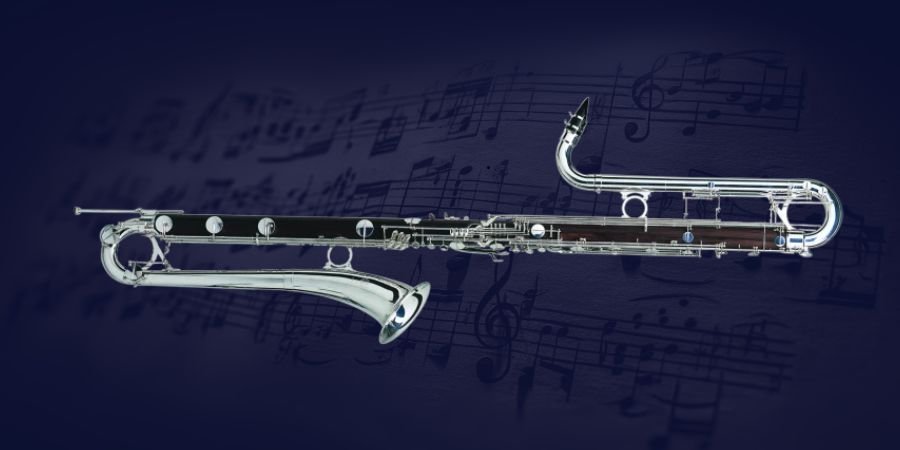
A contrabass clarinet is the deepest in pitch and has very profound and rich sound qualities that extend to lower pitches, such as one or two octaves lower than the pitch played in a bass clarinet. The instrument, as a woodwind with physical depth, contributes to the modern world in genres such as classical and cinema music.
The development of the contrabass clarinet has been from an infrequent dialogue instrument to a goal quality mark of contemporary music. The world is getting increasingly enamored with an immersive experience of an emotion evocator, and the music artists/makers are opening the window towards the world of sound developed by the instrument with the lowest sound frequency.
What Is a Contrabass Clarinet and How Does It Work?
The contrabass clarinet is a large woodwind instrument, most commonly pitched in B♭, though E♭ models also exist. Its long, folded body allows it to produce extremely low frequencies while maintaining the distinct tonal character of the clarinet family.
How low can a contrabass clarinet play?
Most modern contrabass clarinets can descend to written low E♭, sounding C1, with extended-range models reaching even lower. These frequencies are felt as much as they are heard, giving the instrument its signature physical presence.
Despite its size, the contrabass clarinet retains surprising clarity. Unlike electronic bass or brass instruments, its reed-based sound provides articulation and texture even in the lowest register.
How Does the Contrabass Clarinet Differ from the Bass Clarinet?
While the bass clarinet is already considered a low instrument, the contrabass clarinet operates in an entirely different sonic role.
Key differences between bass and contrabass clarinet
-
Pitch depth: The contrabass sounds at least an octave lower
-
Function: Bass clarinet often carries melody; contrabass provides foundation
-
Physical design: Contrabass instruments are floor-supported and significantly larger
In modern ensemble writing, the two instruments are frequently paired. The bass clarinet delivers flexibility and motion, while the clarinet anchors harmony and space.
Where Is the Contrabass Clarinet Used Today?
Contemporary classical and wind ensemble music
In the last two decades, composers such as John Adams and Georg Friedrich Haas have expanded low-register writing, making the contrabass clarinet a natural choice for extended techniques, sustained textures, and spectral harmony.
Wind ensembles increasingly program works that exploit the instrument’s ability to redefine balance and depth, particularly in large performance halls.
Film, television, and game scoring
In cinematic scoring, low frequencies shape emotional response. I’ve personally worked on projects where clarinet replaced synthesized sub-bass to achieve a more organic, unsettling tone—especially effective in psychological thrillers and science-fiction narratives.
The instrument blends seamlessly with modern hybrid scores while maintaining an unmistakably acoustic identity.
Experimental jazz and improvisation
Improvisers influenced by figures like Anthony Braxton use the contrabass clarinet for drones, multiphonics, and rhythmic grounding. Its capacity for both chaos and control makes it ideal for exploratory performance.
A Real-World Example: Adding Contrabass Clarinet to an Ensemble
I collaborated with a contemporary European ensemble that introduced a contrabass clarinet for a new commissioned work. The goal was to eliminate electronic bass while maintaining physical impact in large venues.
Results from live performance
-
The instrument projected clearly without amplification
-
Audience members described the sound as “felt in the chest”
-
The ensemble retained clarity even in dense orchestration
The success of that project led to the contrabass clarinet becoming a permanent part of the ensemble’s instrumentation, reshaping how future works were programmed.
How Does the Contrabass Clarinet Affect Ensemble and Production Costs?
Financial considerations
-
Instrument cost: Higher than bass clarinet due to size and engineering
-
Maintenance: Requires specialized technicians
-
Transport: Large cases and logistics planning are essential
Maximizing return on investment
-
Share instruments across institutions or conservatories
-
Program works that feature the instrument prominently
-
Partner with manufacturers for long-term artist support
Leading manufacturers such as Buffet Crampon, Selmer Paris, and Leblanc continue to innovate in ergonomics and sustainability, making modern models more reliable and accessible.
How Difficult Is the Contrabass Clarinet to Play?
The contrabass clarinet is demanding but not inaccessible.
Who typically plays it?
Most performers transition from bass clarinet. Strong air support, embouchure stability, and refined intonation skills are essential, but modern key systems have significantly reduced technical barriers.
Common technical challenges
-
Breath control for sustained low passages
-
Physical endurance during long performances
-
Precise intonation in extreme registers
With proper training, the instrument rewards players with unparalleled expressive depth.
The Role of the Contrabass Clarinet in the Future of Music
As immersive audio formats and spatial sound design become mainstream, acoustic instruments capable of producing physical low frequencies are increasingly valuable. The clarinet offers something digital tools struggle to replicate: human-controlled depth with organic variation.
Manufacturers are also responding to sustainability standards and institutional procurement guidelines, aligning instrument production with broader environmental and cultural responsibility frameworks.
Key Takeaways
| Area | Insight |
|---|---|
| Musical Role | Foundational low-frequency voice |
| Primary Uses | Contemporary classical, film, jazz |
| Accessibility | Advanced but achievable |
| Investment Value | High artistic impact |
| Future Outlook | Growing relevance in immersive audio |
Frequently Asked Questions
Is the contrabass clarinet louder than a tuba?
No, but its focused low-frequency projection often feels more present in acoustic spaces.
Is it used in traditional orchestras?
Rarely, though contemporary orchestral works increasingly include it.
Can students learn the contrabass clarinet?
Advanced students can, particularly those with bass clarinet experience.
Does it replace electronic bass instruments?
In some settings, yes—especially when organic sound is preferred.
What is the most common mistake composers make?
Overwriting. The instrument needs space to resonate effectively.
Conclusion
Contrabass clarinet is now no longer a novelty or expensiveness; it is rather an instrument of strength and expressiveness that is now available to composers and musicians interested in authenticity and emotion. Music continues to evolve towards an increasingly engaging and interactive kind of experience; contrabass clarinet is now at the junction of past and present styles.