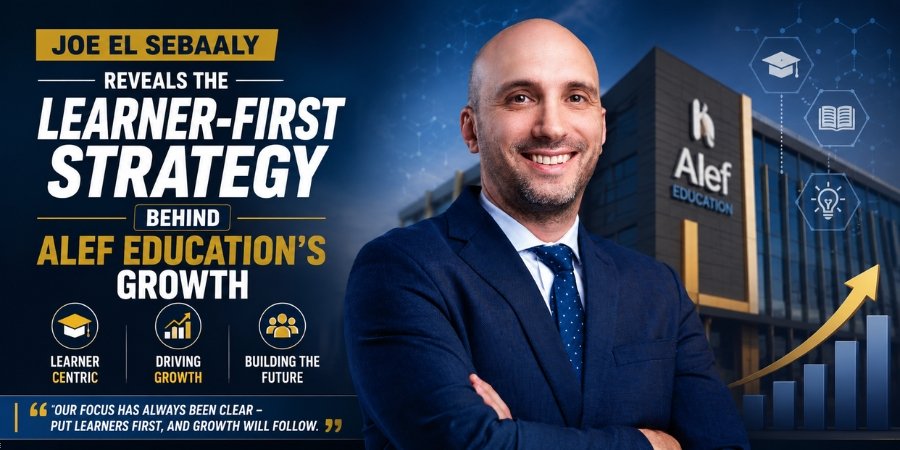
Joe El Sebaaly, Chief Product Officer at Alef Education, says the company’s expansion to nearly two million students across three countries has been guided by a learner-first product philosophy rather than technology for its own sake. In an interview published by Business Today Middle East on August 20, 2026, El Sebaaly described how Alef Education combines education expertise, artificial intelligence and data-driven insights to develop personalised learning experiences.
Alef Education now reaches approximately two million students and 84,000 educators across 19,000 schools in the United Arab Emirates, Indonesia and Morocco, according to the report. The company was also ranked the No. 1 EdTech company in the Middle East and Africa and 13th globally in TIME’s World’s Top EdTech Companies 2026 list.
Joe El Sebaaly Puts the Learner Before the Technology
For Joe El Sebaaly, product development starts with understanding the needs of students and educators. His approach reflects more than two decades of experience across technology and education technology, including leadership roles at Pearson and McGraw-Hill.
“From the beginning, our focus has been on combining educational expertise with technology to create personalised learning frameworks and experiences that improve student engagement and outcomes,” El Sebaaly said in the interview.
That principle influences how Alef Education evaluates new products and features. Rather than treating technology as the starting point, the company says it considers the practical challenges faced by learners, teachers and education systems before developing solutions.
The approach has also produced measurable results in the UAE. Students using Alef Pathways recorded a 5.67% improvement in academic performance, while students using Alef’s AI tutor, Toki, recorded a 4.18% improvement, according to the Business Today report.
AI Is Being Positioned as a Classroom Support Tool
Artificial intelligence has become a central part of Alef Education’s product strategy, with data used to monitor student progress, support personalised learning and provide educators with greater visibility into learner needs. Toki, the company’s AI tutor, is designed to provide additional support to students while working alongside teachers.
Joe El Sebaaly said the objective is not simply to introduce more technology into education. Instead, AI should contribute to learning experiences that are more personalised and responsive while helping educators make better-informed decisions.
“AI’s greatest opportunity in education lies in its ability to enhance personalised learning, provide educators with deeper insights and enable more adaptive and responsive learning experiences,” El Sebaaly said.
The company’s wider product ecosystem includes Alef Pathways, Abjadiyat and Arabits. Together, these products form part of Alef Education’s effort to address different learning requirements while keeping educators central to the process.
Product Decisions Draw on Data and User Feedback
According to Joe El Sebaaly, Alef Education’s development process incorporates feedback from users, education stakeholders, academic data and emerging technology trends. The company uses those inputs to refine its solutions and maintain their relevance to the communities using them.
Operating across three different countries also requires adaptation. The UAE, Indonesia and Morocco have distinct curricula, education priorities and classroom environments. El Sebaaly said Alef works with local education stakeholders to understand those differences and adjust its technology accordingly.
This balance between a common technology foundation and market-specific requirements is central to Alef Education’s international model.
A Product Strategy Focused on Educator Empowerment
Joe El Sebaaly’s comments position AI as an enabler rather than a substitute for teachers. He argues that emerging technologies should help educators deliver more personalised and engaging learning experiences at scale while allowing teachers to concentrate on core educational responsibilities.
Alef Education’s leadership profile confirms that El Sebaaly oversees the company’s product and AI strategy, including its product vision and efforts to create value for students, educators and institutional partners. He holds bachelor’s and master’s degrees in computer science from the American University of Beirut and an MBA from London Business School.
The direction outlined by Joe El Sebaaly reflects a broader emphasis within Alef Education on applying AI and digital learning technology to specific educational needs. For the company, the stated priority remains the same: technology should serve the learner, strengthen educators and support measurable learning outcomes.
This news has been compiled using information gathered from various platforms and is intended for general informational purposes only.