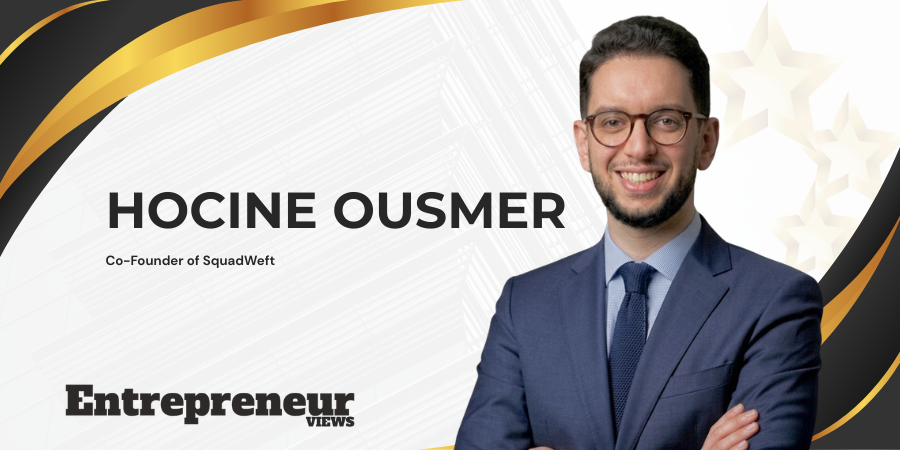
Hocine Ousmer: Turning Ideas, Technology, and Human Potential into Growth
Startup growth is often described through familiar numbers, funding raised, users acquired, markets entered, or revenue generated. But behind every ambitious company is something less visible and often more decisive: the people building it.
Ousmer’s experience across technology, AI, data, and growth has brought him close to founders, engineers, marketers, investors, and creators working to turn ambitious ideas into reality. Along the way, he has seen a recurring challenge: talented people are everywhere, yet the right combination of skills, ambition, and trust can be surprisingly difficult to find.
That belief is now closely connected to his work with SquadWeft, a platform built around a deceptively simple question: What if finding the right people to build with could be as easy as finding the right opportunity?
Beyond Networking: Building with Purpose
Professional networking has expanded far beyond conferences and business cards. Digital platforms, specialist communities, industry events, and online conversations now allow people to meet potential collaborators from almost anywhere.
Yet being connected does not necessarily mean being aligned.
Ousmer recognized a gap between meeting people and actually building something with them. Traditional networking often begins with a profile: What do you do? Where do you work? What is your experience?
His approach begins somewhere else: What are you trying to build, and who do you need beside you?
That distinction is central to SquadWeft. Instead of treating professional relationships as collections of contacts, the platform places projects and ambitions at the center. A developer may need a designer. A founder may need a growth specialist. A creator may need a producer. An entrepreneur may have the vision but need a complementary co-founder.
The objective is not simply to increase the number of connections. It is to improve the quality of the collaboration.
The New Currency of Startup Growth
For Ousmer, talent should not be evaluated only through credentials or impressive résumés.
The strongest teams are built around complementary capabilities, shared ambition, and trust.
Skills create the ability to execute. Ambition provides momentum. Trust gives people the freedom to disagree, experiment, adapt, and continue when the original plan inevitably changes.
This perspective is particularly relevant to startups, where uncertainty is part of the operating environment. Products change. Markets shift. Business models evolve. Early assumptions prove wrong.
A team that looks impressive on paper can still struggle if its members cannot communicate or adapt. Conversely, a smaller group of people with complementary strengths can accomplish remarkable things when they share a common purpose.
For Ousmer, startup growth therefore begins before the pitch deck, before the funding round, and sometimes even before the product exists.
It begins with the people.
AI Is Changing the Team Equation
Artificial intelligence is accelerating this transformation.
Today, a small team can accomplish tasks that once required much larger organizations. Developers can prototype faster. Marketers can test campaigns rapidly. Designers can explore more concepts.
But Ousmer sees an important paradox emerging.
The more powerful individuals become through AI, the more valuable meaningful collaboration may become.
When technology reduces the time required for execution, the bottleneck moves elsewhere—to ideas, judgment, creativity, relationships, and teamwork.
This creates an opportunity for a new generation of highly capable, compact startup teams. A handful of talented people, equipped with AI and complementary expertise, can potentially achieve what once demanded an entire department.
That is precisely where Ousmer sees the relevance of SquadWeft: helping capable individuals discover one another and turn distributed talent into focused execution.
From Connections to Collaboration
Ousmer’s philosophy also challenges the traditional idea that a person’s existing network determines their opportunities.
If someone knows the right people, they may have access to talent, investors, mentors, and collaborators. But someone entering a new ecosystem—or building their first company—may not have those advantages.
The result is a hidden inequality of opportunity.
SquadWeft seeks to shift that equation by moving the question from “Who do I know?” to “Who do I need?”
That change may appear subtle, but it represents a fundamentally different way of thinking about professional collaboration.
A project becomes the meeting point.
An ambition becomes the common language.
Skills become complementary building blocks.
And people who might never have encountered one another through traditional networking can discover a reason to work together.
The Marketing Leader as a Growth Architect
This philosophy also reveals why Ousmer’s approach to marketing extends beyond campaigns and communications.
Modern startup marketing is no longer simply about generating visibility. It is about understanding people, identifying opportunities, building communities, communicating value, and creating the conditions for sustainable growth.
Technology can amplify a message, but it cannot determine whether the message matters.
Data can reveal patterns, but people still need to interpret them.
AI can accelerate execution, but strategic judgment determines where that execution should be directed.
For Ousmer, the intersection of technology, marketing, and human potential is therefore where meaningful growth happens.
His experience across technology and startup ecosystems has also given him a broad understanding of how different disciplines must work together. His involvement with major technology events and communities—including VivaTech, RAISE Summit, and West Data Festival—has further connected him with the people and ideas shaping Europe’s innovation landscape.
Building the Teams Behind Tomorrow’s Companies
Perhaps the most compelling element of Ousmer’s vision is its simplicity.
A great idea does not automatically become a great company.
Execution requires people.
And the right people do more than fill skill gaps. They challenge assumptions, introduce new perspectives, create momentum, and help transform an individual vision into something larger.
Ousmer believes the next generation of startups will increasingly be built by small, highly capable teams empowered by technology but strengthened by human collaboration.
His ambition for SquadWeft reflects that belief: to create a global environment where ideas can find the people capable of bringing them to life.
Imagine an entrepreneur in Paris connecting with a machine-learning engineer in Berlin, a designer in Barcelona, and a growth specialist in London—not because they happened to share the same professional network, but because their skills and ambitions aligned around a common project.
That is the kind of borderless collaboration Ousmer envisions.
Growth Begins with the Right People
The startup ecosystem often celebrates the founder, the product, the technology, and the funding.
Hocine Ousmer draws attention to something equally important: the squad behind the vision.
His perspective offers a more human definition of growth. Technology can make creation faster. AI can make individuals more capable. Global connectivity can make collaboration easier. But none of these advantages can replace trust, complementary talent, shared ambition, and the willingness to build together.
That is the principle at the heart of Ousmer’s work.
His message to aspiring founders is equally direct: do not wait until everything is perfect to begin. Start with the idea, share it, challenge it, and find the people who can help make it stronger.
Because the next great startup may not begin with a perfect business plan.
It may begin with one person, one idea, and one question:
Who should build this with me?
And for Hocine Ousmer, answering that question could be one of the most important steps toward shaping the next generation of startup growth.